
field notes on the third coast_
chicago tech week and a summer spent meeting researchers, founders, and operators across chicago, nyc, and sf


If you spend enough time at a startup event in Chicago, someone will eventually ask why innovation doesn’t seem to “stick” in the Midwest the way it does in the glass towers of New York or the hacker houses of San Francisco.
I understand why the comparison persists. Entrepreneurship on the coasts is undeniably loud and visible. Founders meet investors over dinner. Early employees leave one startup to build another. Talent, capital, and information move quickly, often through the same rooms, until startup life begins to spill beyond institutions and scheduled events and becomes part of the city’s social fabric.
I’ve spent much of this summer moving between Chicago, New York, and San Francisco, meeting founders and operators through my fellowship with Inflect. I’d just wrapped my first year at Kellogg when the travel began, and Chicago Tech Week brought me back into the city last week. At this point, I’m admittedly a zombie. But the summer has also been exhilarating!
Leaving Chicago and returning to it has sharpened my view of the Midwest startup ecosystem. The gaps are easier to see now, as is the work the ecosystem still has ahead of it. But surprisingly, the comparison has also made me more optimistic about what’s already here and what it could become.
There are brilliant scientists, world-class universities, major healthcare institutions, and plenty of ambitious people working on consequential problems here. The challenge, however, is turning invention into enduring companies, then giving the talent and capital created by those companies enough reason to stay in the region. 1
the itinerary…
where I found energy ✦ ⋆.˚
Many of the companies that excited me most this summer grew out of years (sometimes decades!) of research. Their teams included accomplished physicians, scientists, and engineers working on problems they had encountered firsthand in hospitals, labs, and their own clinical practice.
I saw that depth especially clearly in medtech and biotech, across areas like medical imaging, diagnostics, and wearable bioelectronics. Many of these founders had spent years understanding the problem before it ever occurred to them to build a company around a solution.
One of my favorite moments was attending the Advanced Wearables and the Future of Clinical Trials industry day, where I got a closer look at Northwestern’s bioelectronics ecosystem. Listening to Dr. Steve Xu, Professor John Rogers, and the broader community of researchers working across medicine and engineering, I was genuinely star-struck (which I later admitted to Dr. Xu at an ISTC event).
The work felt technically ambitious, clinically grounded, and much closer to science fiction than most people probably realize. In an email to Dr. Dave Feldman, our Head of Strategic Technology Partnerships, about one of the companies, I gushed: “IMO, the technology itself is transformative... something straight out of a sci-fi movie!!!”
The UChicago and Nucleate Demo Days gave me a similar energy. I met and reconnected with founders like SlideFlow Labs’ Akhil Chakravarti and Feinberg student Eric Jia, who are thinking seriously about how AI could reshape clinical workflows. They’re researchers and builders trying to turn highly technical work into products that can survive contact with the real world.
Much of this is happening in labs and clinical environments, far from the places we usually picture when we hear the word “startup.” Some of the people behind the work wouldn’t even describe themselves as entrepreneurs.
Seeing it up close, it’s clear to me that the Midwest has no shortage of invention.
the gap between invention and company-building
Here’s perhaps my most pointed observation from this summer: the Midwest doesn’t yet commercialize its research at the level its science deserves.
I met founders with differentiated technology, years of supporting research, and credible teams. But I often understood the science behind a product way before I understood the business around it. During intro chats, I found myself circling the same few questions: Who feels this problem urgently enough to buy? How does the product make its way into an institution? What evidence will persuade someone to change an established behavior or workflow? And does this really have the potential become venture-scale?
Investor storytelling is part of the challenge. Researchers are trained to communicate with precision, qualify their claims, and demonstrate technical rigor. Fundraising asks them to take years of complexity and distill it into only the essentials: what problem they’re solving, who needs the solution, and how large the opportunity could become. The scientific credibility still has to hold up, of course. But investors and customers also need to understand why the tech matters without sitting through a dissertation.
A better pitch deck alone won’t solve the deeper issue. Commercialization is a discipline of its own, spanning the likes of customer discovery, regulatory strategy, reimbursement, manufacturing, recruiting, and sales. A physician may understand a clinical problem more deeply than almost anyone and still need serious help building a durable, venture-backable company around that insight.
That support needs to begin earlier. Academic founders should have experienced commercial leaders and product operators beside them before important decisions become difficult to reverse. Universities need to treat faculty entrepreneurship as a legitimate part of the job. And customers and strategic partners should enter the conversation before the science is considered “finished,” giving the product and business model time to evolve together.
the operators companies need
Starting a company is hard, but learning how to grow one is, arguably, even harder.
PitchBook analysis suggests Midwest startups can take about 18 months longer than their coastal peers to raise their first $500,000. That lag may create understandable pressure for founders to spend more time on the coasts, where capital and startup networks are more concentrated. And because startup moves tend to happen early, it makes me wonder how many founders and early employees who begin building here get to see the full arc of a startup in the Midwest — from product discovery and building out a team to raising later rounds and figuring out how to sell something repeatedly — or end up accumulating that experience somewhere else.
Over time, that exposure matters. Someone who’s lived through painfully long enterprise sales cycles can often tell whether a slow quarter is part of the process or a sign that the GTM strategy is broken. You don’t learn that kind of judgment from a panel or an accelerator curriculum. You learn it by making decisions with incomplete information, watching what happens, and carrying those lessons into the next company.
And this is where the Midwest runs into a chicken-and-egg problem. Startups need experienced operators to help them scale, but operators need enough compelling startups to build a career around. One interesting role may be enough to bring someone here. Staying is easier when there are several ambitious companies, meaningful financial upside, and other opportunities nearby if the first bet doesn’t work out.
I don’t think the answer is simply recruiting a few seasoned execs and hoping they stay. Instead, the goal should be making it possible for builders to imagine an entire career here: moving between startups, advising younger founders, investing in new companies, and passing what they’ve learned forward.
what scarcity teaches… and what it costs
Capital is harder to come by in the Midwest, and many founders I’ve met here build and raise with that constraint in mind. Carta’s 2024 data helps explain some of that caution: startups in the region secured just 4% of all capital raised on the platform in Q1. That’s down from 7% the year before, and a stark contrast to the coasts, where the West captured 62% of the funding and the Northeast secured 23%. Founders often relied on university resources, grants, clinical collaborators, and friends-and-family rounds before approaching institutional investors. Teams stayed lean. Founders bootstrapped longer and thought carefully about what they needed to prove before asking someone else to fund the next stage.
That felt noticeably different from many of the founders I met on the West Coast, where it was more common to see people raising around a bold idea before a product fully existed. In the Midwest, the question often seemed less like, “How quickly can I raise?” and more like, “How much can I prove before I have to?” Founders were expected to arrive with much of the risk already ironed out, whether that meant a fully functioning product, early pilots, or evidence of behavior change.
I understand that instinct.. But some questions can only be answered once someone is willing to fund the attempt. When nearly everything has to be ruthlessly de-risked before even an early stage raise, I wonder how many promising ideas never get far enough to show what they could become.
There’s real value in the resourcefulness this creates. It keeps founders close to customers and pushes them to gather the evidence adoption will actually require. Lower operating costs help, too. A founder can hire, rent space, run experiments, and live reasonably for less in Chicago, Cleveland, or Minneapolis than in NYC or SF. In healthcare, where sales cycles are long and product development can take years, that extra runway matters.
But resourcefulness shouldn’t become a euphemism for being chronically underfunded. A founder can spend months piecing together grants and small checks while a less differentiated competitor, backed by more capital, moves faster. Lower burn is only an advantage when the company can still raise enough to hire the right people, complete the necessary validation, and reach the milestones its industry demands.
a community worth building on
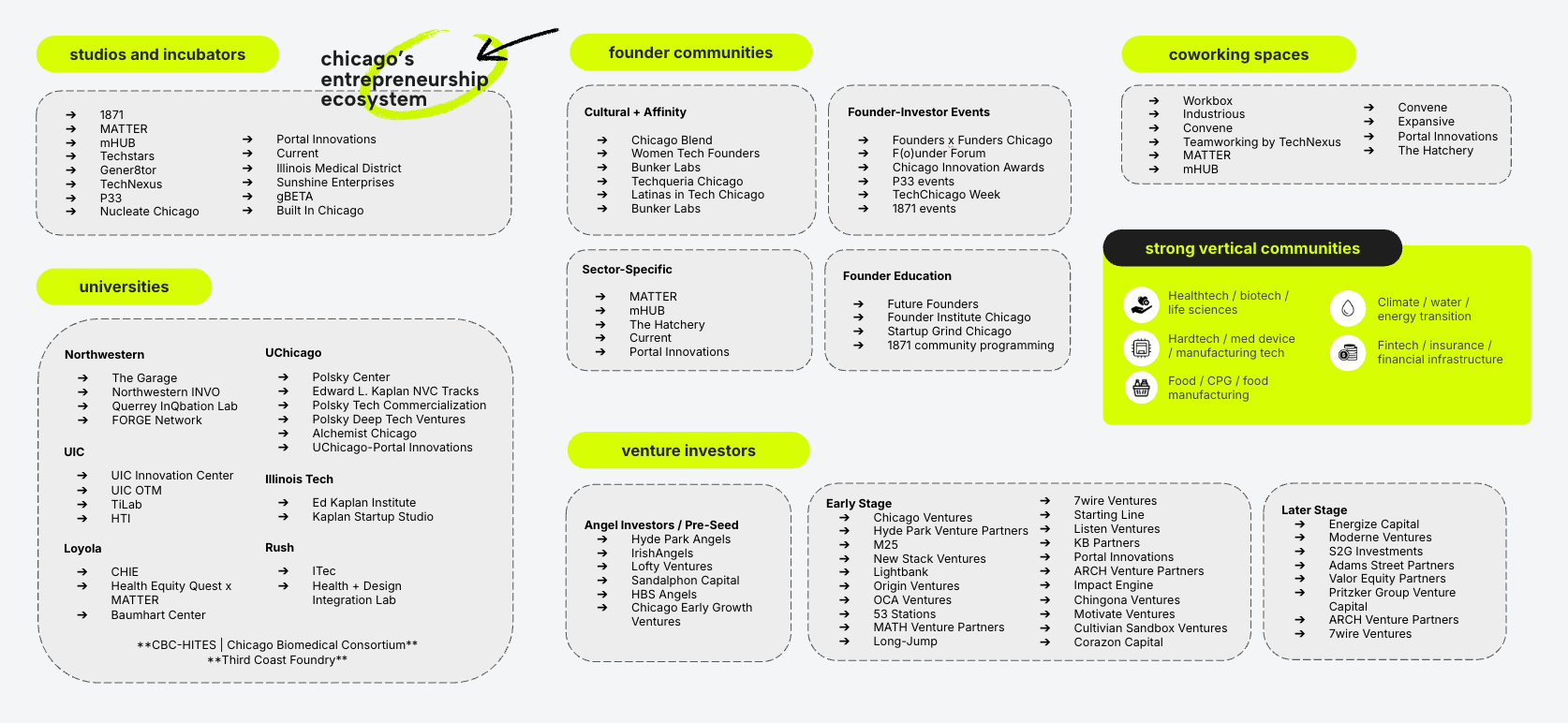
The thing that charmed me most about Chicago’s startup ecosystem was how interconnected it felt. The teams behind mHUB, MATTER, Portal Innovations, Nucleate, and Third Coast Foundry are all helping founders find their next step. And because the community is relatively small, one thoughtful intro often leads to several more.
I felt that so clearly during a Nucleate Demo Day at mHUB, when my friends and I ran straight into Jamie Shah, President of Chem-Impex and former CEO of The Spice House, in the elevator. She was the keynote speaker, mind you.. Still, she answered our never-ending list of questions warmly, extended her network, and even drove us to the Metra station in the pouring rain.
That moment still gets me grinning. It captured something about the closeness of this ecosystem: people make time, relationships can form quickly, and even someone still learning her way around can feel invited in.
what I’d love to see next ᯓ★
There’s already so much here worth building from. What still seems harder to recreate is the frequency of the coasts: the sheer number of times people run into one another, trade ideas, work together, and just keep showing up.
I’d love to see more spaces that extend beyond a single conference or panel, helping turn those initial connections into repeated, working relationships. Those gatherings matter (+ many of my own relationships this summer have started there). But the relationships that shape companies develop over time. Founders need places where they can encounter each other regularly, build beside one another, and get to know operators across their broader industry.
That could look like founder residencies, operator office hours, small group dinners, or sector-specific coworking groups. While these scrappier formats may sound less impressive than a major summit, they create the trust and familiarity that make people more willing to share problems early and help one another solve them.
I’m still new to this ecosystem, and people who have spent years building and investing in it will notice things I’ve missed. I’m not convinced the Midwest is on the verge of becoming the next great startup hub, and I don’t know how long meaningful change will take. But I’m leaving the summer with a much deeper appreciation for what’s being built here, and a genuine curiosity about how much further it could go with the right support.
A quick note on scope: most of what follows comes from my time in Chicago, Illinois. I draw on broader Midwest data where it’s relevant, but one city obviously can’t reflect the full diversity of startup communities across the region.